It's 1am. You're not sad, exactly. You're just — wrong. Your chest is a little tight. You keep picking up your phone. Nothing satisfies. You're reading comments under a YouTube video about anxious attachment not because you need to learn something new. You already know it. You're reading because other people describing your exact experience is the only thing that makes the loneliness bearable.
Here's what's actually happening: you're hungry.
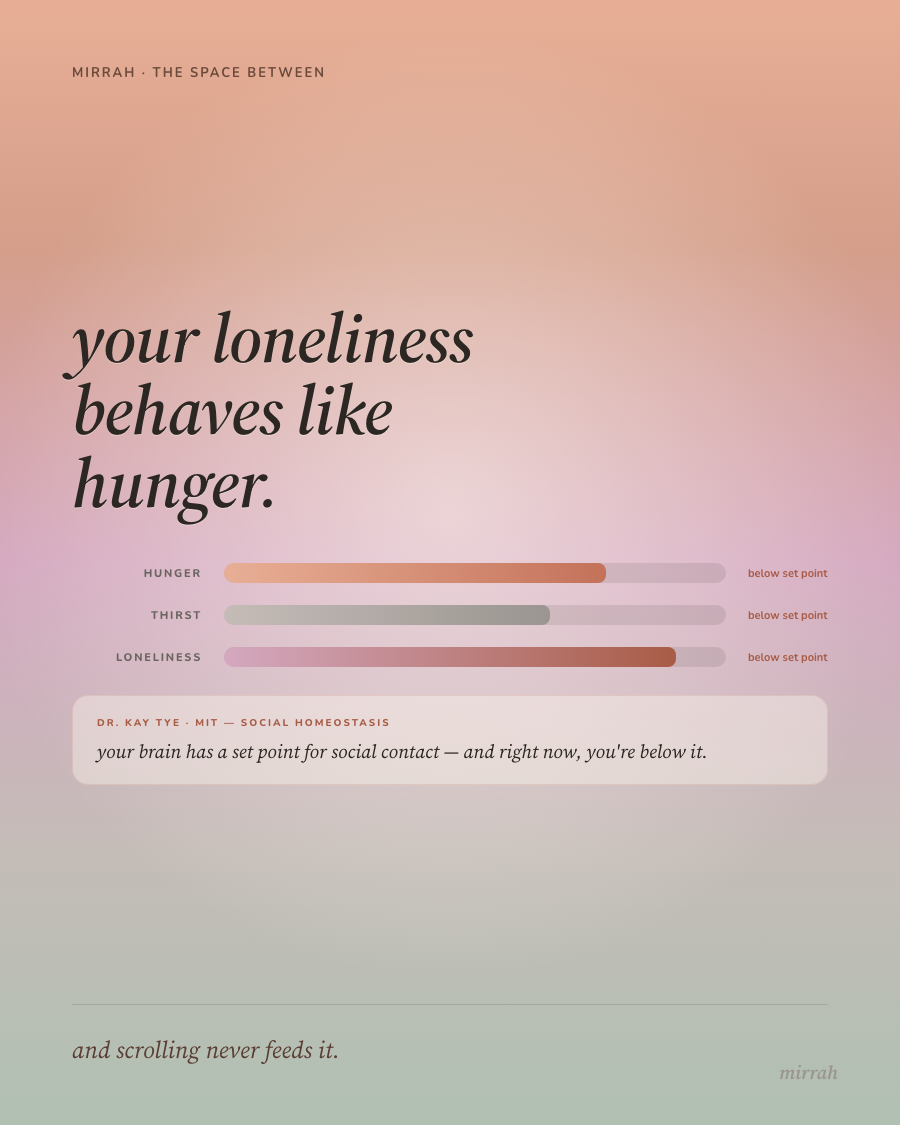
Your brain has dedicated neurons whose entire job is to monitor your social contact levels against a calibrated set point. When actual contact drops below that set point, those neurons generate a real, unpleasant need state. Dr. Kay Tye, director of the Systems Neuroscience Lab at MIT's McGovern Institute, calls this social homeostasis — and the 1am doomscroll is your loneliness circuit trying to eat. The problem is that scrolling is pictures of food. It does not feed the circuit. And the circuit knows.
Why does being alone feel like a physical ache?
Because it is one. Loneliness isn't a mood. It's a biological drive — structurally identical to hunger or thirst — driven by neurons that monitor your actual social contact against your brain's expected baseline.
Dr. Kay Tye's lab at MIT discovered what she calls "loneliness neurons" in the dorsal raphe nucleus, a region in the brainstem. When mice were socially isolated, these neurons fired — and the animals showed the same kind of motivated, compulsive drive to seek social contact that hungry animals show toward food. When researchers stimulated these neurons artificially, the effect was the same: a push toward social connection, not toward food or play or anything else. The need state was specific.
Tye describes this as social homeostasis: the brain maintains a set point for social contact the same way it maintains set points for temperature, hunger, and hydration. You don't decide to feel lonely any more than you decide to feel hungry. The signal fires first. The conscious experience comes after.
This matters because it changes the frame. The 1am phone reach isn't weakness. It isn't a bad habit. It isn't you failing to "sit with discomfort." It's a homeostatic drive. It's your brain doing exactly what it's supposed to do when it detects a deficit.
The question is just: is the thing it reaches for capable of filling the gap?
What are "loneliness neurons" and where do they live?
In the dorsal raphe nucleus — a small cluster of neurons in the brainstem, best known for its role in serotonin regulation. Dr. Tye's lab identified a distinct subset of these neurons that respond specifically to social isolation. They don't fire when the animal is physically uncomfortable or food-deprived. They fire when it's alone.
The discovery was partly accidental: Tye's team was studying cocaine and dopamine when they noticed that saline-injected control mice who were also separated from their peers showed similar neurological signatures to the cocaine-exposed mice. The isolation itself — not the drug — was doing something to the brain. That observation led to the identification of the loneliness circuit.
Why doesn't scrolling fix loneliness?
Because your loneliness circuit isn't asking for information about other people. It's asking for interbrain synchrony — the real-time physiological entrainment between two nervous systems that happens during live contact.
Dr. Lisa Feldman Barrett (Northeastern University) describes humans as "the caretakers of each other's nervous systems." Co-regulation — the biological process through which two nervous systems influence each other through shared gaze, synchronized voice, physical proximity — is not a metaphor. It's a metabolic event. When it happens, your body budget shifts. The cost of staying regulated drops.
Social media is asynchronous. A like is a delayed, one-directional signal. A comment thread is text without tone, without timing, without breath. Your loneliness circuit receives this information and runs a check: did that feed the need? The answer is no. So it fires again.
Dr. Huberman's research team notes explicitly: social media does not provide the interbrain synchrony required to satisfy social homeostatic needs. The circuit is built to expect live input. It cannot be fooled by representations of live input.
This is why the scroll doesn't stop. Each swipe delivers a small, variable dopamine hit — enough to briefly suppress the loneliness signal, not enough to resolve it. The loneliness circuit and the dopamine circuit are running simultaneously, which creates the sensation of compulsion: you don't want to scroll, but you can't stop, because the underlying need is unmet.
What is interbrain synchrony — and why does it matter?
Interbrain synchrony refers to the coupling of two nervous systems in real time through shared sensory channels: gaze, voice, micro-timing of response, and physical proximity. It's the mechanism through which humans have always co-regulated — calmed each other down, matched arousal states, reduced the metabolic cost of maintaining emotional equilibrium.
Research on mother-infant pairs, therapeutic alliances, and musical improvisation all show measurable physiological synchrony between people in live contact. Heart rate variability syncs. Respiratory patterns align. The nervous systems are, literally, running at the same tempo.
This is what the loneliness circuit is asking for. Not news about someone's life. A synchronized nervous system.
| Biological signal | Neural mechanism | What it needs | What scrolling delivers | Satisfied? |
|---|---|---|---|---|
| Hunger | Ghrelin neurons (hypothalamus) | Calories — metabolic input | Images of food | No |
| Thirst | Osmoreceptors | Water | Videos about water | No |
| Loneliness | Loneliness neurons — dorsal raphe nucleus (Dr. Kay Tye, MIT) | Interbrain synchrony — live nervous system contact | Asynchronous information | No |
| RSD spike (ADHD) | Amygdala hyperactivation (Dr. Alok Kanojia, Healthy Gamer GG) | Felt validation + co-regulation | Variable-ratio likes/comments | ~90 seconds |
The table makes the pattern visible. Every biological drive has the same problem with substitutes: the circuit checks, the substitute fails the check, the drive intensifies.
Does ADHD make this cycle harder to exit?
Yes — not because the loneliness is more intense, but because the gap between signal and action is near zero.
The ADHD brain has what researchers call a compressed impulse-to-action gap. When the loneliness circuit fires, the phone is already in hand before the prefrontal cortex has had time to ask: will this actually help? The RSD (rejection sensitive dysphoria) layer compounds this. For someone with ADHD and anxious attachment, a quiet evening can feel identical to rejection — same somatic signature, same amygdala activation, same desperate reach for connection.
The result is a cycle the rational brain can observe but not stop:
- Loneliness neurons fire (below set point)
- Impulsive reach for phone (ADHD gap — no deliberation)
- Scroll delivers dopamine novelty (circuit briefly suppressed)
- Circuit checks: need unmet
- Drive intensifies
- Return to step 2
Naming what's happening doesn't break the cycle automatically. But it changes the relationship to it.
What actually feeds the loneliness circuit?
Synchronous contact. Live.
It doesn't have to be long. A 10-second video call. A voice note replied to immediately. Being in a room with someone — even working in parallel silence. What matters is the real-time nervous system signal: someone else's nervous system is present and responsive.
Dr. Marc Brackett (Yale Center for Emotional Intelligence) describes co-regulation as the mechanism through which two people's nervous systems actively influence each other's states. It's the biological baseline. Humans are not equipped to regulate in permanent isolation. The circuit isn't a design flaw — it's a feature.
What if synchronous contact isn't available at 1am?
The most useful first move is naming the signal precisely.
Dr. Lisa Feldman Barrett's research shows that labeling an internal state — with specificity, not just "I feel bad" — activates the brain's linguistic centers and measurably reduces amygdala activation. The act of articulating "my loneliness neurons are firing; this is a need state, not an emergency; the set point dropped today and it will recover" creates a small but real window between the signal and the action.
That window is where choice lives.
Not the choice to feel nothing. Not the choice to "sit with discomfort" (a phrase that implies discomfort is optional). The choice to wait for real food instead of eating pictures of food.
3 Takeaways
1. Loneliness has neurons. Dr. Kay Tye found them in the dorsal raphe nucleus. They fire exactly like hunger neurons — not as a mood, as a biological drive. The 1am chest tightness isn't fragility. It's homeostasis.
2. Scrolling soothes for ~90 seconds. Then your loneliness circuit checks: did that feed the need? It didn't. The scroll wasn't self-soothing. It was snacking on empty calories while the hunger circuit ran louder.
3. The 1am doomscroll isn't a character flaw. It's a hunger signal aimed at the wrong food. The circuit is asking for a live nervous system. The phone can't give it that. But naming the signal — precisely, without shame — creates enough space to wait for the real thing.
FAQ
Why does loneliness feel physically painful? Because it is a physical signal. Dr. Kay Tye (MIT McGovern Institute) identified "loneliness neurons" in the dorsal raphe nucleus that generate a genuine need state during social isolation — biologically parallel to the mechanism of hunger. The ache reflects actual neural activity, not emotional excess or weakness.
Why does scrolling social media make me feel more lonely? Your loneliness circuit is requesting interbrain synchrony — the real-time nervous system entrainment that occurs during live contact. Social media is asynchronous: it delivers information about people without the biological signal of their presence. The circuit checks, finds the need unmet, and intensifies. The scroll suppresses the signal briefly; it does not resolve it.
What is social homeostasis? The brain's calibrated set point for social contact, identified by Dr. Kay Tye (MIT). Just as the body regulates body temperature and blood glucose, it regulates social connection. When actual contact drops below the set point, loneliness neurons fire a drive-like need state — before any conscious decision about how you "should" feel.
Does ADHD make loneliness worse? The loneliness signal itself may not be stronger, but the ADHD brain's compressed impulse-to-action gap means the response (reaching for the phone) happens before the rational brain can assess whether it will help. The mismatch between need and tool goes unexamined — and the cycle repeats with each unrewarding scroll.
What actually satisfies the loneliness circuit? Synchronous connection. A voice call, shared physical presence, a brief live video call. Real-time contact produces the interbrain synchrony — nervous system coupling through voice, gaze, and mutual timing — that the circuit is actually requesting. The length or depth of the interaction matters less than the fact that it is live.
Why is the 1am scroll so hard to stop? Two circuits run simultaneously. The loneliness circuit fires a need state. The dopamine circuit responds to the variable-ratio reinforcement of scrolling — novelty and occasional reward that briefly suppresses the need signal without resolving it. The hunger remains. Each swipe delays it without feeding it.
Can naming loneliness actually help? Yes — in the moment. Dr. Lisa Feldman Barrett's research shows that labeling an emotional state activates the brain's linguistic centers and reduces amygdala activation. "My loneliness neurons are firing; this is a need state, not an emergency" creates cognitive distance between signal and action. It doesn't eliminate the need. It creates a window.
Is the 1am doomscroll a bad habit? It's a biological signal aimed at the wrong tool. The impulse is real and homeostatic. Framing it as a bad habit implies willpower is the solution. Framing it as misdirected hunger points toward the actual question: what would actually feed this? That reframe doesn't shame the behavior. It redirects the search.
The 1am scroll is not a moral failure. It's a navigation error. Your brain is using the right map — find social contact, reduce the need state — but the tool you're reaching for can't complete the journey.
Mirrah is built for the gap between the signal and the real solution. When the need fires and synchronous contact isn't available yet, there's still something useful to do: name it exactly, sit with it long enough for the acute spike to pass, and wait for real food instead of eating pictures of it.
The circuit knows the difference. Eventually, so do you.