Why am I so emotional for no reason?
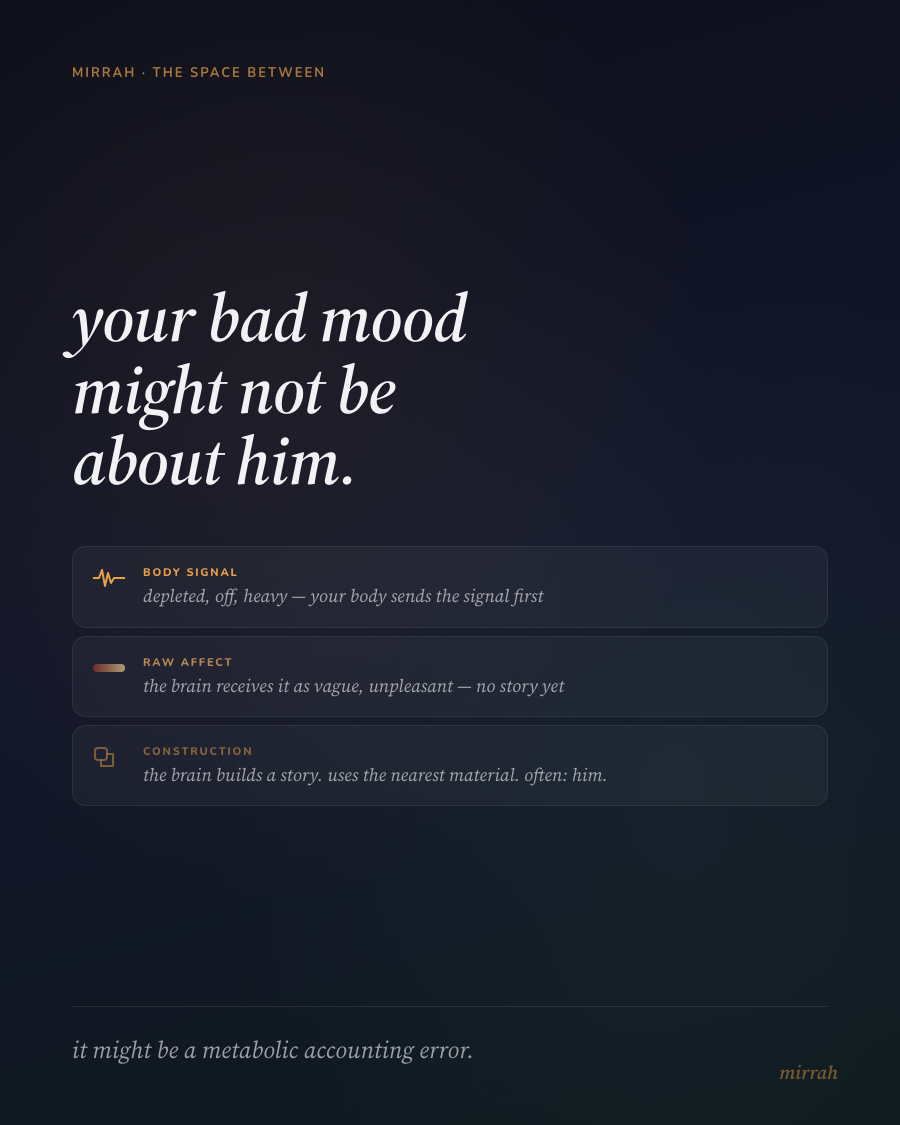
Your brain is running a budget — glucose, sleep, salt, water — and when that budget is bankrupt, it registers the deficit as psychological distress before you form a single conscious thought.
The emotion comes first. The story about why you feel it comes second — assembled in milliseconds from whatever relationship material happens to be nearby.
Dr. Lisa Feldman Barrett calls this allostasis — the brain's actual primary job: managing the body's physical resources, predicting what those resources need before you are even aware of a problem. The sensory signals the body sends back do not arrive as labeled emotions. They arrive as raw affect — a vague, unpleasant, heavy sense that something is wrong. Then the brain builds a story to explain it.
If you slept three hours, skipped lunch, and your medication window closed at 6 PM — the story the brain builds at 1 AM will be about him. Not about your glucose.
What is a "body budget" and why does it drive bad moods?
The body budget is Dr. Lisa Feldman Barrett's framework for allostasis — the brain's continuous process of predicting and regulating your body's physical resources. In Barrett's words: "your brain is running a budget for your body and it's not budgeting money it's budgeting glucose and salt and oxygen... you can think about withdrawals from that budget like burning glucose... deposits like sleeping and eating... savings... and taxes".
Deposits: sleep, food, water, movement, connection. Withdrawals: stress, poor sleep, skipped meals, dehydration, sustained emotional labor. Taxes are the slow, structural drains — chronic anxiety, ADHD cognitive overhead, the constant background hum of hypervigilance.
When the accounts go negative, the brain generates distress signals. Those signals are the raw material for whatever emotion gets constructed next. The brain is a prediction machine. It needs a cause. Whatever is emotionally salient at that moment — your relationship, your job, your self-worth — gets assigned the bill.
What is the "emotional flu"?
The emotional flu is Barrett's term — coined first by her daughter — for a bad body-budget day. Her exact framing: "the emotional flu is when you're having a bad body budgeting day and you're just like you didn't get enough sleep maybe or you know there's some stress".
Everything feels wrong. You are not falling apart. You are metabolically depleted, and the brain is generating distress signals to prompt a physical correction. The error is in the interpretation — mistaking the body's repair request for a psychological crisis.
The tell: physical input changes the feeling. If eating protein, sleeping, or moving for twenty minutes shifts the mood, it was the emotional flu. If the feeling stays unchanged after physical repair, that is when the psychological story deserves real attention.
How is it different from an actual emotional problem?
Barrett is direct: "sometimes it's productive not to turn that negative affect into an emotion... sometimes you just need to deal with the affective problem by dealing with your physical state".
The emotional flu responds to metabolic inputs. A real psychological problem sits there after you've slept and eaten — unchanged, still asking to be looked at.
How can lack of sleep cause a bad mood — is that a real mechanism?
It is a mechanism, not a metaphor. When sleep debt accumulates, the body budget goes negative. The brain registers the depletion as low-dimensional affect — bad, heavy, wrong. Because the brain constructs emotion by finding a cause for whatever it is sensing, it drafts a story from whatever psychological material is available.
Barrett notes that when people have a bankrupt body budget — from lack of sleep, poor nutrition, or metabolic issues — "they will feel intense distress and fatigue, which the brain will incorrectly interpret as a purely psychological problem".
The bad mood is real. The story about what caused it may be borrowed from the wrong source.
Before you text: check the budget first.
| What it feels like | What the brain calls it | What the body is actually doing | Test first |
|---|---|---|---|
| "Something is wrong with us" | Relationship anxiety | Sleep debt — cortisol elevated, affect tanked | Sleep. Check the feeling in the morning. |
| "He doesn't care about me" | Rejection / abandonment fear | Glucose crash — brain low on metabolic fuel | Protein snack. 20 minutes. Check the certainty. |
| "Everything is falling apart" | Existential dread | Stimulant medication window closed, dopamine/norepinephrine drop | Expect it 5–7 PM. Pharmacological, not relational. |
| "I can't handle this" | Emotional overwhelm | Dehydration or skipped meals — visceral distress signals elevated | Water, food, ten minutes. |
| "I'm too sensitive" | Shame about the response | Normal affect — body accurately reading depletion | It is accurate data. The interpretation is the variable. |
Why do ADHD brains get hit harder by body budget crashes?
The ADHD brain is already running on executive function debt. Higher cognitive load. More frequent cortisol spikes from the daily friction of managing time blindness, task initiation failures, and rejection-sensitive responses. Sleep architecture disrupted by racing thoughts that won't switch off.
Add a stimulant medication window that closes at 5–7 PM — suppressing appetite all day, then dropping dopamine and norepinephrine as the medication clears. By late afternoon, many ADHD adults hit a glucose trough, a medication crash, and the loss of the work-structure scaffold simultaneously.
The body budget is bankrupt three ways at once. The brain constructs the darkest available story from whatever material is at hand. The relationship is usually nearby.
Is the 1 AM spiral actually about the relationship?
Sometimes. Not always.
The 1 AM certainty that everything is falling apart — that he's pulling away, that you're too much, that this is about to end — arrives at the exact hour when glucose is lowest, sleep pressure is highest, and the medication window has been closed for hours.
Barrett's guidance: before trying to use "mentalizing Jedi tricks" to regulate emotions, first secure a good night's sleep, healthy food, and exercise. The spiral at 1 AM is real. The conclusions it generates may be a body budget problem, not a relationship fact.
The text can wait until the budget is replenished.
Can you think your way out of a body budget crash?
No — and trying to is a losing battle.
Cognitive reframing requires a brain with the metabolic resources to reframe. A bankrupt brain constructs distorted stories and then uses those distorted stories as the raw material for the reframing attempt. You are debugging the output when the problem is the operating system.
Barrett advises addressing the physical state first: "sometimes it's productive not to turn that negative affect into an emotion... sometimes you just need to deal with the affective problem by dealing with your physical state". She is explicit that sleep, food, and movement precede cognitive work — not as nice additions, but as prerequisites for the brain to function accurately.
Dr. Marc Brackett adds a useful precision: the right tool depends on the source. "When you're feeling chronic envy, you know doing breathing exercises is not going to decrease the envy — you're going to have to work on your construction in your mind. But maybe I got a really shitty night's sleep and I just need to recognize that I'm never going to be the best version of myself no matter how hard I try because I haven't replenished the resources of my brain".
Metabolic problem, metabolic fix. If the source is psychological, no amount of protein is going to resolve it — but you'll see that more clearly once the budget isn't bankrupt.
Three takeaways
1. Your brain doesn't give you an emotion. It builds one — from your body's physical state and the nearest available story. A depleted body budget always drafts a darker story. (Dr. Lisa Feldman Barrett, allostasis model)
2. The 1 AM certainty that everything is falling apart is real. The question is whether the brain borrowed it from your relationship or from three hours of sleep and no dinner.
3. Before asking "what's wrong with me," ask "what's wrong with my budget." Sleep, protein, movement, water — these are the metabolic inputs the brain uses to run its emotional math.
Before you text
The affect is accurate data. The chest tightness, the heaviness, the sense that something is wrong — the body budget genuinely is low, and the brain is reporting it correctly.
What the brain gets wrong at 1 AM with no sleep and no food is the story it builds to explain the signal.
The feeling: earned. The conclusion: second opinion required.
Mirrah sits between the body signal and the text. The question it asks is: budget problem, or him? Those are different problems. They have different fixes.
FAQ
Q: Why am I so emotional for no reason? Your brain is running a metabolic budget — glucose, sleep, water, salt. When it goes bankrupt, the brain generates raw distress signals (affect) and constructs a psychological story to explain them. Dr. Lisa Feldman Barrett's research shows the emotion is built from physical state plus nearest available story. Sometimes there's no psychological reason — just a depleted body budget generating the sensation of one.
Q: Can lack of sleep actually cause a bad mood, or does it just make me more reactive? Both — through the same mechanism. Sleep debt creates metabolic withdrawals from the body budget. The brain reads the deficit as low-dimensional affect (bad, heavy, wrong) and builds a story to explain it. Barrett notes that people with a bankrupt body budget "will feel intense distress and fatigue, which the brain will incorrectly interpret as a purely psychological problem." The bad mood is real. The story it lands on may not be accurate.
Q: What is the "emotional flu"? A term coined by Dr. Lisa Feldman Barrett's daughter for a bad body-budgeting day — not enough sleep, physical stress, poor nutrition — where everything feels emotionally wrong. Test: change the physical inputs. Eat protein, drink water, sleep. If the feeling shifts significantly, it was the emotional flu. If it persists unchanged after physical repair, the feeling has something real to tell you.
Q: What is allostasis and why does it matter for mood? Allostasis is the brain's continuous job of predicting and managing the body's physical resources: glucose, salt, oxygen, water. It runs beneath conscious thought. When resources go negative, the brain generates distress signals. Those signals become the raw material for whatever emotion gets constructed next — regardless of whether the actual cause is metabolic or relational.
Q: Can I think my way out of a body budget crash? No — cognitive reframing requires metabolic resources. Barrett's guidance is explicit: address the physical state before attempting cognitive work. A bankrupt brain constructs distorted stories and uses those stories as reframing material. Sleep, food, and movement come first — not as self-care add-ons, but as prerequisites for accurate emotional reasoning.
Q: Why does my ADHD make body budget crashes worse? The ADHD brain runs higher cognitive load and cortisol by default, with sleep often disrupted by racing thoughts. Stimulant medication can suppress appetite through the afternoon, creating a glucose trough at exactly the hour when the medication window closes. By late evening, sleep debt, glucose deficit, and medication crash can all arrive simultaneously — leaving the brain to build stories from severely depleted resources.
Q: Does this mean my feelings aren't real? The affect — the chest tightness, the heaviness, the sense something is wrong — is accurate data. The body budget is low and the brain is reading it correctly. What is unreliable is the specific story built from that signal at 1 AM with no food and four hours of sleep. The 1 AM conclusion about your relationship may be a body budget problem wearing an emotional costume. That distinction matters for what you do next.
Q: What should I do when I think I'm having a body budget crash? Before building a story about the cause: eat something with protein, drink water, note whether it's the end of your medication window, check how much you've slept. If the distress shifts significantly after physical repair, that is information. If it stays, the feeling deserves real exploration — ideally from a rested, fueled starting point, not from the middle of the crash.