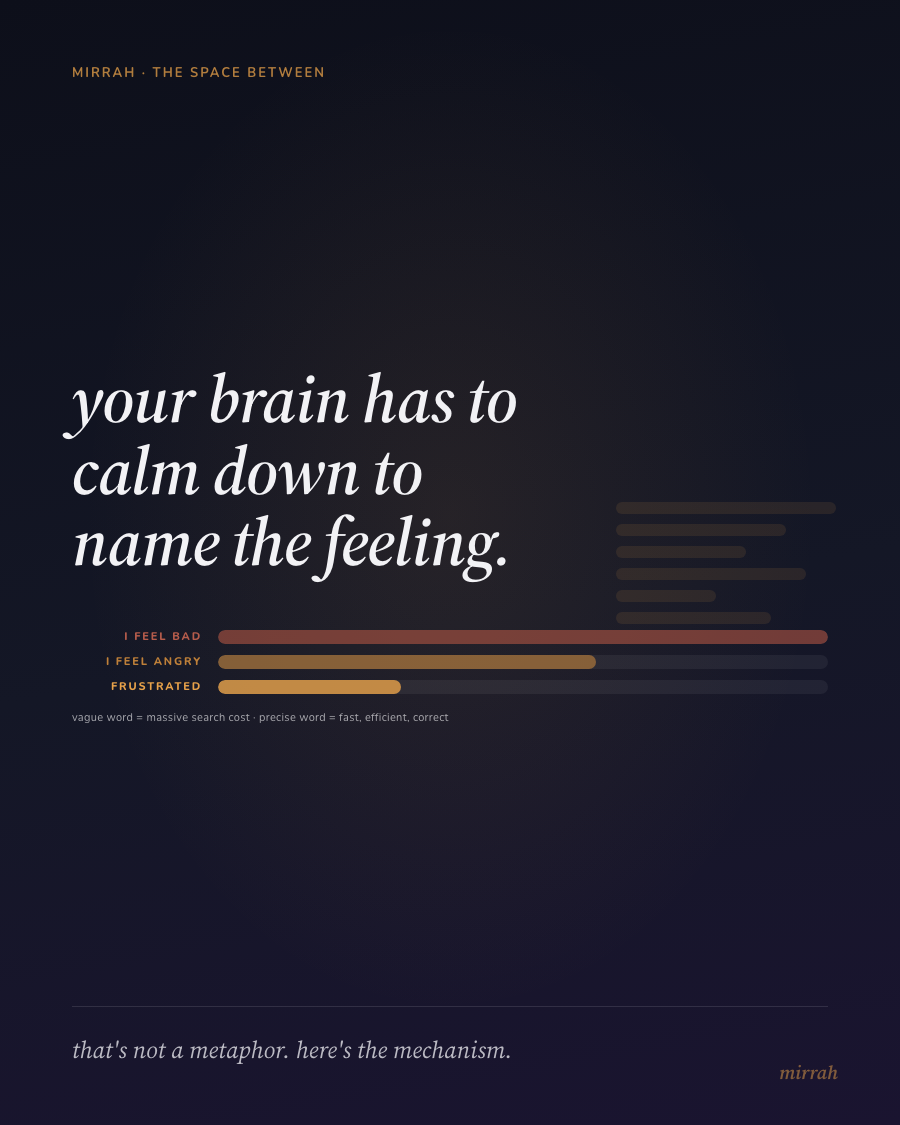
Naming your feelings calms your amygdala. Not because it feels good to have a word for the thing. Because your brain structurally cannot produce language while the amygdala is at full volume — so the naming and the quieting are the same event.
That's the mechanism. Affect labeling — putting a feeling into words — is one of the few emotional regulation techniques where the neuroscience is clear and the expert consensus is unusually tight. Dr. Alok Kanojia, Dr. Marc Brackett, Dr. Lisa Feldman Barrett, and Dr. Andrew Huberman all converge on it.
But there are two things the "just name your feelings" version gets wrong. And if you've noticed that naming your spiral doesn't stop it, those two things are probably why.
Does naming your emotions actually work, or is it just another coping cliché?
Naming works — and the mechanism is structural, not motivational.
When your amygdala is hyperactive, it floods the brain and drowns out competing regions. To put a word to what you're feeling, your brain has to engage the linguistic centers — Broca's area, primarily. Broca's area cannot run at full intensity while the amygdala is running at full intensity. They compete for the same neural resources.
Dr. Alok Kanojia describes it directly: "the more angry you are the more your amygdala is like hyperactive it is drowning out every other part of your brain so the first thing that you have to do is put words to it... the moment that you try to put words to it it has to calm down in order for your linguistic centers broca's area and all these in order for them to articulate it you have to understand it."
His conclusion: "in order to put words to it we have to tone it down some." [Kanojia, HealthyGamerGG]
This is why affect labeling is a foundational component of what psychiatrists call distress tolerance. It's not a coping cliché. It's a brain architecture constraint working in your favor.
What's the actual brain mechanism — what is Broca's area doing?
Broca's area is your brain's language production center. It requires relative quiet from the amygdala to function. When you force language onto an activated state, you're not suppressing the emotion — you're engaging a competing system that requires the emotional centers to step back enough to let language through.
The calming isn't a reward for naming. It's a prerequisite for naming. The naming and the calming happen as a single event.
How much does it actually calm things down?
Enough to matter. Not enough to end the spiral alone. This distinction is everything.
Naming reduces the intensity of activation — specifically the amygdala's hyperactivity — enough to bring the prefrontal cortex partially back online. That partial return is what makes the next steps (choosing a strategy, noticing what's real vs. what's story) even possible.
It is step one. Not the whole sequence.
Why does naming it not stop the spiral?
Two reasons. Both matter.
First: body first, always. At peak activation — hands shaking, chest tight, full amygdala hijack — your physiology is already mid-response before your brain has formed a thought. Naming requires enough linguistic capacity to form a word. If the body's physiological arousal is at its peak, language can't land yet. One physiological breath first. One real exhale — not a ten-minute breathing exercise, not a protocol. One breath, then the word. Body before mind before action. Always this order.
Second: naming the wrong thing points to the wrong fix. If "stressed" and "anxious" feel the same, you'll apply the same tool to both. They're not the same. They require different responses. And that's where emotional granularity — the precision of the word — becomes the actual work.
What is emotional granularity, and why does the precise word matter?
Emotional granularity is the ability to differentiate between specific emotional states rather than defaulting to broad categories. Dr. Lisa Feldman Barrett coined the term. Dr. Marc Brackett built an entire framework around it.
Barrett explains the stakes through a library analogy. When your brain tries to regulate an emotion, it searches for the right response:
- "if you use the category bad this feels bad then your brain is basically going to be partially constructing an entire Wing full of books like a entire Wing full of options." [Barrett]
- "if you use the word angry then maybe it's a bookcase it's constructing a bookcase full of options."
- "if you were using the word frustrated then maybe it's a shelf."
The precise word narrows the brain's predictive search. That narrowing is not just more accurate — it's metabolically efficient. Your nervous system coordinates faster when the category is specific.
Barrett: "The more words you know the more words are just useful for pointing to a set of features that are similar to each other," allowing the nervous system to efficiently coordinate the body's response. [Barrett]
What's the difference between anxiety, stress, pressure, and fear?
All four feel "bad." All four are distinct. Brackett names them precisely:
| Word | What it actually means | Why the tool differs |
|---|---|---|
| Anxiety | Uncertainty about the future | May need a cognitive strategy, not breathing |
| Stress | Too many demands, not enough resources | May need removal of demands, not reappraisal |
| Pressure | Something at stake that depends on your behavior | May need preparation or grounding |
| Fear | Immediate danger | May need physiological regulation first |
Brackett: "if I'm anxious because I'm worrying about the future you know maybe the breathing exercise is not going to be as helpful because maybe I need a cognitive strategy." [Brackett, Yale Center for Emotional Intelligence]
Misname it. Misapply the tool. Wonder why nothing works.
Dr. Andrew Huberman adds that tools like the "Mood Meter" — plotting states on axes of energy and pleasantness — can build the emotional vocabulary needed to make labeling precise rather than approximate. [Huberman Lab]
Why do all four experts agree on this?
The consensus across Kanojia, Brackett, Barrett, and Huberman is unusually clean. From the research synthesis: "Putting precise words to feelings (Emotional Granularity/Labeling) is critical for regulation" — listed as a point of universal expert agreement. Every framework centers it differently, but they all land in the same place.
Kanojia: first step of distress tolerance. Brackett: the "L" in RULER — the hinge between recognizing and regulating. Barrett: the mechanism by which the brain constructs emotion efficiently. Huberman: the tool for adding adaptive nuance to nervous system states.
This is the one thing. Not because it does everything. Because nothing else works without it.
What about RSD — if I can name it, why does it still hit like a freight train?
Because naming doesn't prevent the initial hit. It changes what happens next.
RSD fires in the amygdala before the prefrontal cortex has time to form a thought. The naming happens after the hit arrives. What affect labeling does in the context of RSD:
- It shortens the activation window by bringing the prefrontal cortex online faster
- It points to the right regulatory tool (not all amygdala activation is the same kind)
- It interrupts the second spiral — the shame about having had the first one
She knows — she knows — this is RSD. She can name it. Naming it does not stop it. But naming it precisely, body-first, changes how long she's in it and what she does next.
Mirrah is built for that gap.
3 Takeaways
- Your brain has to calm down to name the feeling. The calming is the prerequisite, not the reward. Broca's area needs the amygdala to quiet — and the attempt to name it is what triggers the quiet.
- "I feel bad" sends your brain into an entire wing of possible responses. "I feel frustrated" narrows it to a shelf. Precision isn't emotional literacy homework. It is the mechanism.
- Naming is the on-ramp. Granularity is the steering. Body-first is the brake. Affect labeling is real, it is step one, and it does not work alone at peak activation.
FAQ
Does naming your feelings actually reduce anxiety? Yes — structurally, not symbolically. Naming a feeling forces Broca's area, your brain's language center, to engage. The amygdala must quiet down for that to happen. Dr. Alok Kanojia: "in order to put words to it we have to tone it down some." The calming is a neurological side effect of the naming, not a separate step.
What is affect labeling in psychology? Affect labeling is the practice of putting emotions into words. Research and clinical practice — including the work of Kanojia, Brackett, and Barrett — consistently show that naming an emotion reduces its intensity by forcing linguistic brain regions online, which requires the hyperactive amygdala to decrease activity. It is foundational to distress tolerance.
What is emotional granularity and why does it matter? Emotional granularity, a term coined by Dr. Lisa Feldman Barrett, is the ability to differentiate between nuanced emotional states rather than defaulting to broad categories like "bad" or "stressed." The more specific the word, the narrower the brain's search for the right response — which means faster, more accurate regulation and less metabolic cost.
Why does naming the feeling not always stop the spiral? Because labeling is step one, not the whole ladder. At peak activation — heart pounding, hands shaking, full amygdala hijack — the body is already mid-response before the brain catches up. Body-first regulation (even one physiological exhale) is needed before labeling can land. And if the label is imprecise, the wrong tool follows.
What's the difference between anxiety and stress, and why does it matter? Dr. Marc Brackett distinguishes them precisely: anxiety is uncertainty about the future; stress is too many demands and not enough resources. They feel similar. They require different fixes. Wrong label, wrong tool.
Can affect labeling help with RSD? Partially — and this matters. RSD fires in the amygdala before the prefrontal cortex has time to form a thought. What labeling does: it shortens the activation window, points to the right regulatory response, and interrupts the shame spiral that follows. It doesn't prevent the hit. It changes what happens next.
Is this the same as "just name your feelings"? No. "Just name your feelings" implies naming is simple, passive, and sufficient. Affect labeling is a specific neurological mechanism with a defined sequence: body first, then one precise word, then the right tool for that word. Vague labeling has minimal effect. Precision is the mechanism.
Does this work if I already know what I'm feeling? Knowing the name and naming it mid-activation are different cognitive acts. Recognition is intellectual. Labeling during the spiral requires engaging language centers while the amygdala is actively competing for the same resources. The doing is the regulation. Not the knowing.
The short version
You're not going to name your way out of the hit. The hit arrives before the word.
But once it's arrived — naming it precisely, one word, body first — that's not a coping tip. That's a neurological mechanism with four experts behind it and a specific sequence that works.
Body. Then the word. Then the right tool for that word.
Mirrah is built for the moment between the trigger and the text — the window where the word is possible but the impulse is still loud. That window is real. This is what happens inside it.
<script type="application/ld+json"> { "@context": "https://schema.org", "@type": "FAQPage", "mainEntity": [ { "@type": "Question", "name": "Does naming your feelings actually reduce anxiety?", "acceptedAnswer": { "@type": "Answer", "text": "Yes — structurally, not symbolically. Naming a feeling forces Broca's area, your brain's language center, to engage. The amygdala must quiet down for that to happen. Dr. Alok Kanojia: 'in order to put words to it we have to tone it down some.' The calming is a neurological side effect of the naming, not a separate step." } }, { "@type": "Question", "name": "What is affect labeling in psychology?", "acceptedAnswer": { "@type": "Answer", "text": "Affect labeling is the practice of putting emotions into words. Research and clinical practice — including the work of Kanojia, Brackett, and Barrett — consistently show that naming an emotion reduces its intensity by forcing linguistic brain regions online, which requires the hyperactive amygdala to decrease activity. It is foundational to distress tolerance." } }, { "@type": "Question", "name": "What is emotional granularity and why does it matter?", "acceptedAnswer": { "@type": "Answer", "text": "Emotional granularity, a term coined by Dr. Lisa Feldman Barrett, is the ability to differentiate between nuanced emotional states rather than defaulting to broad categories like 'bad' or 'stressed.' The more specific the word, the narrower the brain's search for the right response — which means faster, more accurate regulation and less metabolic cost." } }, { "@type": "Question", "name": "Why does naming the feeling not always stop the spiral?", "acceptedAnswer": { "@type": "Answer", "text": "Because labeling is step one, not the whole ladder. At peak activation — heart pounding, hands shaking, full amygdala hijack — the body is already mid-response before the brain catches up. Body-first regulation is needed before labeling can land. And if the label is imprecise, the wrong tool follows." } }, { "@type": "Question", "name": "What is the difference between anxiety and stress?", "acceptedAnswer": { "@type": "Answer", "text": "Dr. Marc Brackett distinguishes them precisely: anxiety is uncertainty about the future; stress is too many demands and not enough resources. They feel similar but require different regulatory strategies. Using a breathing exercise for anxiety when what's happening is stress means misapplying the tool." } }, { "@type": "Question", "name": "Can affect labeling help with rejection sensitive dysphoria (RSD)?", "acceptedAnswer": { "@type": "Answer", "text": "Partially. RSD fires in the amygdala before the prefrontal cortex has time to form a thought — naming happens after the hit arrives. What labeling does: it shortens the activation window, points to the right regulatory response, and interrupts the shame spiral that follows. It doesn't prevent the initial hit. It changes what happens next." } }, { "@type": "Question", "name": "Does knowing what you're feeling count as labeling it?", "acceptedAnswer": { "@type": "Answer", "text": "No. Knowing the name and naming it mid-activation are different cognitive acts. Recognition is intellectual. Labeling during the spiral requires engaging language centers while the amygdala is actively competing for the same resources. The act of naming — during activation — is the regulation. Not the prior knowledge." } }, { "@type": "Question", "name": "What order should I use when trying to regulate a strong emotion?", "acceptedAnswer": { "@type": "Answer", "text": "Body first, then word, then tool. At high activation, one physiological exhale before attempting to name the feeling. Then one precise word — not 'bad,' not 'upset,' but the specific word. Then select the strategy that matches that specific word. Body → Mind → Action, always in that order." } } ] } </script>