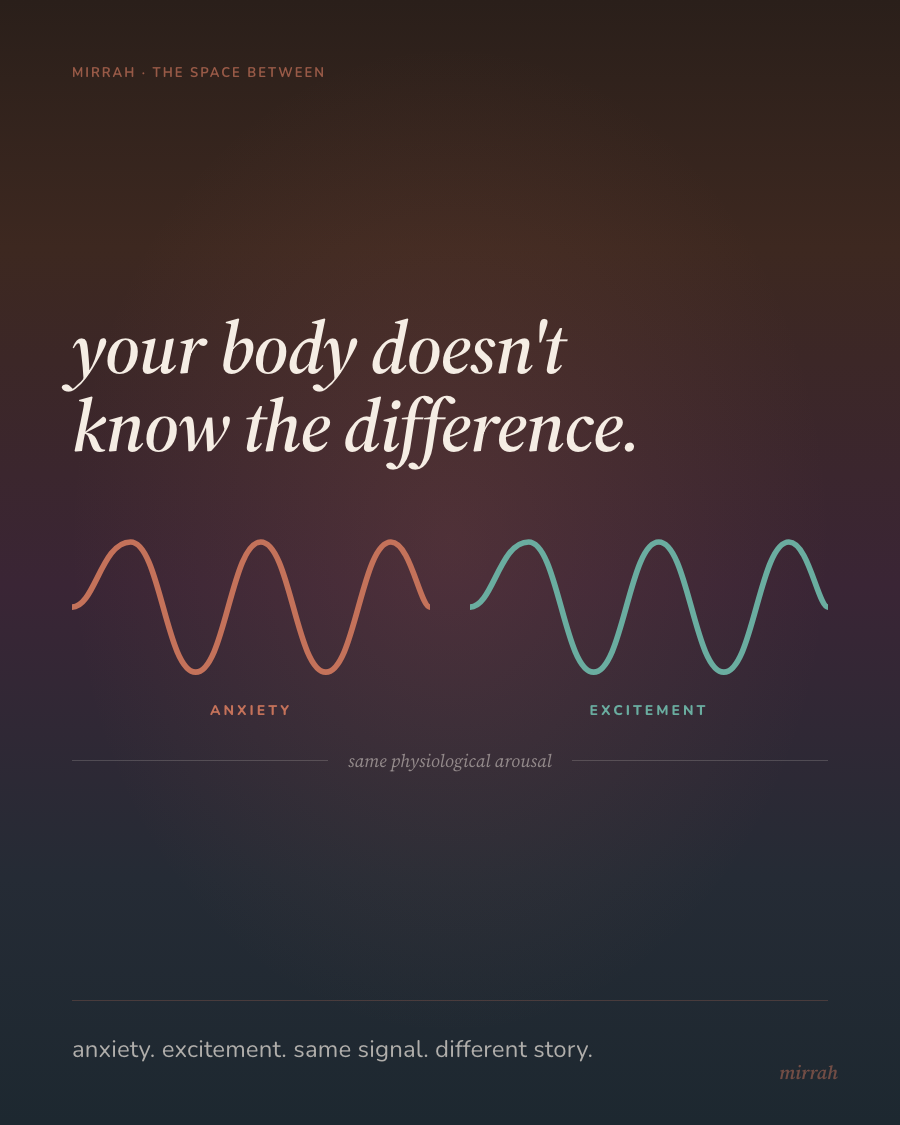
Your chest is tight. Your heart is pounding. Your thoughts are moving at what someone once described as "race car speed with bicycle brakes." Your body is doing one thing. Your brain is filing it under dread.
Here's what Dr. Lisa Feldman Barrett's research actually says: that filing is a construction, not a fact. The same physiological arousal — same pounding heart, same tight chest, same racing energy — is the raw material for anxiety, excitement, or determination. The difference isn't in the signal. It's in the story the brain wraps around it. And the story, at least partly, is something you can intervene in.
That's not toxic positivity. The mechanism is neurobiological. This post is going to show you exactly how it works — and where it honestly doesn't.
Why Does Anxiety Feel Exactly Like Excitement?
Because physiologically, they are the same event.
Dr. Barrett's framework of constructed emotion holds that the brain produces two core biological axes: arousal (how activated your body is) and valence (whether that activation feels good or bad). Anxiety and excitement sit at the same point on the arousal axis — both are high-energy, high-activation states. What differs is valence: the meaning the brain assigns.
Your nervous system doesn't produce distinct "anxiety chemicals" and "excitement chemicals." It produces arousal. The brain then takes that signal and builds an emotion around it — drawing on context, past experience, and prediction to decide what this surge means, and what you should do next.
Dr. Barrett calls these constructed emotions "recipes for action." The recipe for anxiety says: avoid, contract, protect. The recipe for excitement says: approach, open, act. The physiological ingredients are identical. The recipe is written by the brain — and the brain is taking suggestions.
What Does "Butterflies in Formation" Actually Mean?
It's Dr. Barrett's shorthand for a technique with a clinical name: recategorizing physiological signals.
The idea: when you feel the surge of pre-performance anxiety — or the tightening that comes when you're waiting for a text back — you consciously offer the brain a different label. Not "dread." Not "danger." Something like determination. Or "butterflies flying in formation." You're not lying to yourself. You're doing what the brain does automatically, but doing it deliberately: assigning a category to raw arousal so the brain knows what action plan to build.
Dr. Barrett is explicit that changing the label changes the brain's action plan. The arousal doesn't disappear. The body doesn't suddenly go quiet. What changes is what the brain decides to do with the signal.
This is different from CBT's "challenge the thought." You're not arguing with the feeling. You're offering it a better home.
When Does This NOT Work? The Honest Part.
At the absolute peak, it doesn't work. That's the honest part of this, and it matters.
When the amygdala fires — fully activated, hands shaking, RSD arriving like a fact before your rational brain has time to form a complete sentence — the prefrontal cortex is offline. Cognitive tools require the prefrontal cortex. Which means reappraisal is temporarily unavailable.
At the peak, body-first.
Dr. Andrew Huberman's physiological sigh is designed for exactly this: double inhale through the nose (the second one brief, to fully inflate the lungs), followed by a long exhale through the mouth. The mechanism is specific: it offloads CO2, which decelerates heart rate via vagal control of the sinoatrial node, rapidly shifting the autonomic nervous system toward parasympathetic dominance. It's fast. It works during the window when nothing cognitive can.
After that window — approximately 90 seconds — the prefrontal cortex starts coming back online. That's when reappraisal becomes available.
The sequence matters: sigh first, reappraisal second.
What Does This Mean If You Have ADHD and RSD?
This is where the research gets specific in a way that actually lands.
Rejection sensitive dysphoria arrives fully formed. Like a fact. Before the rational brain can even boot up — that's not a metaphor, that's the architecture. The ADHD nervous system processes perceived rejection as a survival-level threat. The amygdala fires fast, the certainty arrives before the prefrontal cortex has anything to say about it, and the surge is somatically indistinguishable from genuine danger.
Dr. Barrett's framework offers the first honest reframe that doesn't ask you to think your way calm while the amygdala is still running the show. Here's what it actually says: that surge is physiological arousal awaiting a label. It is not evidence that the worst interpretation is true. It's raw signal — fast, real, loud — and the story being built around it is a construction, not a fact.
The RSD surge isn't proof of danger. It's your body doing exactly what it's supposed to do with high arousal. The mistake is treating the brain's first-pass label as confirmed truth.
Here's where the relief lives: you can name what's happening. Dr. Alok Kanojia, Dr. Marc Brackett, and Dr. Barrett all converge on this point — putting precise words to a feeling forces the amygdala to yield bandwidth to the brain's linguistic centers, which has a measurable calming effect. "This is RSD. This is arousal. This is my body doing what it does. This is not confirmation." That's not affirmation. That's categorization. And categorization changes the action plan.
Can You Actually Change Which Emotion the Arousal Becomes?
Yes — with two honest caveats.
First, reappraisal works at mid-level activation, not at the peak. The prefrontal cortex has to be functional enough to intervene. After the 90-second amygdala window, it's available.
Second, this is a practice, not a switch. The brain's prediction system is built on years of pattern-matching. The first time you offer a different label, the brain might accept it for 30 seconds before reverting. The 40th time, the window is longer. The brain updates its predictions incrementally — but it does update.
The practical sequence, grounded in what the research actually supports:
1. Surge hits. Physiological sigh. Body first. 2. Watch the 90 seconds. Don't act. 3. Prefrontal cortex back online. Offer the label. "This is determination. These are butterflies flying in formation." 4. The brain accepts the label — because it was looking for a category all along.
The Arousal × Emotion Table
All four emotions in this table share the same physiological arousal level. Only the brain's assigned meaning — the valence and label — differs.
| What you feel in your body | Anxiety labels it... | Excitement labels it... | Determination labels it... |
|---|---|---|---|
| Pounding heart | "Something is wrong" | "This is thrilling" | "I'm mobilized" |
| Tight chest | "I can't handle this" | "I'm activated" | "I'm ready" |
| Racing thoughts | "I'm spiraling" | "My mind is alive" | "I'm focused" |
| Shallow breathing | "I'm panicking" | "I'm amped up" | "My body is gearing up" |
3 Things to Actually Take From This
- The signal is identical. Anxiety and excitement sit at the same point on the arousal axis. The emotion is the brain's construction around the signal — not the signal itself.
- Body-first at the peak, reappraisal second. The physiological sigh works during the window when nothing cognitive can. Reappraisal works after the 90-second amygdala window. The order matters.
- The RSD surge isn't confirmation. It's raw arousal awaiting a label. The certainty it manufactures is the construction. That gap — between the surge and the story — is real, and it's yours.
Frequently Asked Questions
Because they are physiologically identical. Dr. Lisa Feldman Barrett's research shows that the brain produces arousal — a high-energy autonomic state — and then assigns a label based on context and prediction. Anxiety and excitement share the same arousal level on the brain's two-axis system. What differs is valence: the meaning the brain assigns to the signal.
It's Dr. Barrett's shorthand for recategorizing physiological signals. Instead of letting the brain file your pounding heart under "dread," you consciously offer it a new category: determination or focused energy. Changing the label changes the brain's action plan — what it constructs as the "recipe for action." The butterflies don't disappear. They start flying in the same direction.
No. The mechanism is neurobiological, not motivational. You're intervening in the brain's categorization and prediction system — offering it a different label so it builds a different action plan. The arousal stays. The construction shifts.
No — and the research is honest about this. At the absolute peak, the prefrontal cortex is offline and the amygdala is running pattern-match. That's when body-first tools like the physiological sigh (Dr. Andrew Huberman) work. Reappraisal becomes available after roughly 90 seconds, when the prefrontal cortex starts coming back online.
CBT asks you to identify and challenge distorted thoughts. Reappraisal via Barrett's framework doesn't argue with the feeling — it intervenes at the level of categorization. You're not telling yourself the anxiety is wrong. You're offering the arousal a different category. The distinction matters for people whose anxiety is a rational response to real neurological patterns, not a distorted perception.
Yes. Dr. Alok Kanojia, Dr. Marc Brackett, and Dr. Barrett all converge here: precise labeling forces the amygdala to yield bandwidth to linguistic processing centers, which has a measurable calming effect. Naming "RSD" instead of "I'm being abandoned" shifts the categorization — and categorization shapes the action plan.
Expected. The brain's predictions are built on years of pattern-matching. A single reappraisal introduces a new data point — it doesn't overwrite the file. Over time, the brain updates its predictions incrementally. The practice doesn't fail because it doesn't work the first time. It works the way any new neural pathway works: slowly, then faster.
What This Looks Like in Practice
You're at your desk. He still hasn't texted back. Your chest is tight. Your thoughts are at that speed that makes it impossible to work. You can name the feeling: RSD. Arousal. High activation, unpleasant valence.
You know what your body is doing. The surge is real. The certainty it's manufacturing — He's pulling away. This is confirmation. — that's the construction. Not the signal.
The physiological sigh first. Not because it'll make it stop, but because you need the prefrontal cortex back online before you can do anything else useful. One breath. Long exhale. Watch the seconds.
Ninety of them.
Then: offer the label. This is my body mobilizing. This is arousal. This is not proof. Not an affirmation. A categorization. A different recipe for the same ingredients.
You don't have to believe it fully the first time. The brain takes suggestions, but it takes them gradually. The practice is in showing up for the next 90 seconds — and the one after that.
That's where Mirrah lives. Between the surge and the story. Between the trigger and the text.